
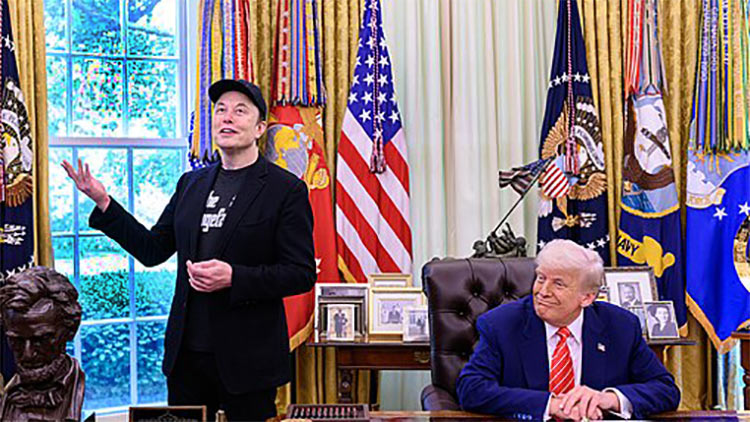
– Elon Musk, CEO of SpaceX, is in a public feud with President Donald Trump over policy and private life comments.
– Musk criticized Trump’s “Big Beautiful Bill,” a controversial tax and spending bill with significant economic implications.
– Vice President JD Vance supports Trump, advising Musk to avoid a public “war” with the president.
– The bill’s supporters claim it aids American households, while critics warn of negative impacts on healthcare and increased national deficit.
– Musk’s critiques are seen as aligning with his business interests, possibly affecting his government contracts.
Connect the Red Dots.
In the high-stakes drama unfolding between two titans of influence, Elon Musk has drawn the battle lines with former ally President Donald Trump. This escalating feud centers on the contentious “Big Beautiful Bill,” purporting to reform tax structures and federal spending while resonating heavily with Trump’s campaign promises, including mass deportations and border wall funding. With Musk criticizing the bill’s financial repercussions, notably on electric vehicle incentives, the stakes are exponentially higher in this clash of ideologies and personalities.
Vice President JD Vance, a loyalist to Trump, has underscored the importance of strategic alliances by urging Musk, an entrepreneur commanding immense technological breakthroughs, to rethink the implications of this conflict. At stake are the equilibrium of domestic policies and the intertwined legacies of these powerful figures.
While supporters of the “Big Beautiful Bill” emphasize its promise to improve the economic standing of American households, the looming threat of Medicaid cuts and elevated deficits has deepened partisan divides. Musk’s opposition, primarily rooted in preserving lucrative incentives for electric vehicles, frames the debate not just in political, but economic terms. Unsurprisingly, Vance aims to shift the narrative towards unity for the ostensible greater national interest.
The bill symbolizes a broader tug-of-war over America’s socio-economic trajectory. Democrats caution against potential destabilization of the healthcare sector, adding pressure to an already volatile legislative arena. Moreover, Musk’s pointed critiques have not only fired up his base but also stirred concerns on Capitol Hill regarding long-term economic security.
Beneath this surface spat lies the broader reality of two competitive visions for America’s future. Should the Senate reject the bill, significant tax increases on households may follow. Conversely, its approval could fulfill Trump’s election promises, impacting manufacturing and investment incentives extensively. The implications for U.S. policy reset the nation’s compass between entrepreneurial vigor and governmental oversight.
Editorial Opinion:
In the twilight zone of media spectacles, this feels akin to a high-stakes poker game — billionaire playboy versus real estate magnate-turn-president. Musk calls Trump a boastful bully, while Vance plays peacemaker like a high school principal in a juvenile squabble. Let’s face it; there’s something entertaining about watching the world’s wealthiest man and the leader of the free world claw at each other over policy beef.
But beyond the theater, what’s glaring is their egos overshadowing the substantial concerns of American families. Instead of bickering over tip-enabled tax breaks or throwing shade about Epstein files, how about a genuine focus on the millions who might lose their healthcare or face intense financial pressures? Musk’s Asperger’s-induced quirks aside, better these two channel their genius where it counts: an America genuinely for the people, by the people—minus the childish antics.
